


Over the last decade, since blogs and music websites ruled the discourse we’ve seen a decline in relevance of mastheads like The Fader, Pitchfork & Pigeons and Planes. Not to diminish the quality of their brands or editorial teams, simply their king maker status became less relevant as social media and personalisation of feeds became the norm. The rise in popularity of TikTok around 2020, its powerful algorithm and ability to place specific content with specific audiences has seen an uprise in creators doubling down on their niches, attracting engaged and passionate crowds of people. Increasingly, the niche is being rewarded. People are inadvertently seeking out depth in knowledge and as they ride the algorithmic wave of feel good, frictionless scrolling want to feel either smarter or joyous.
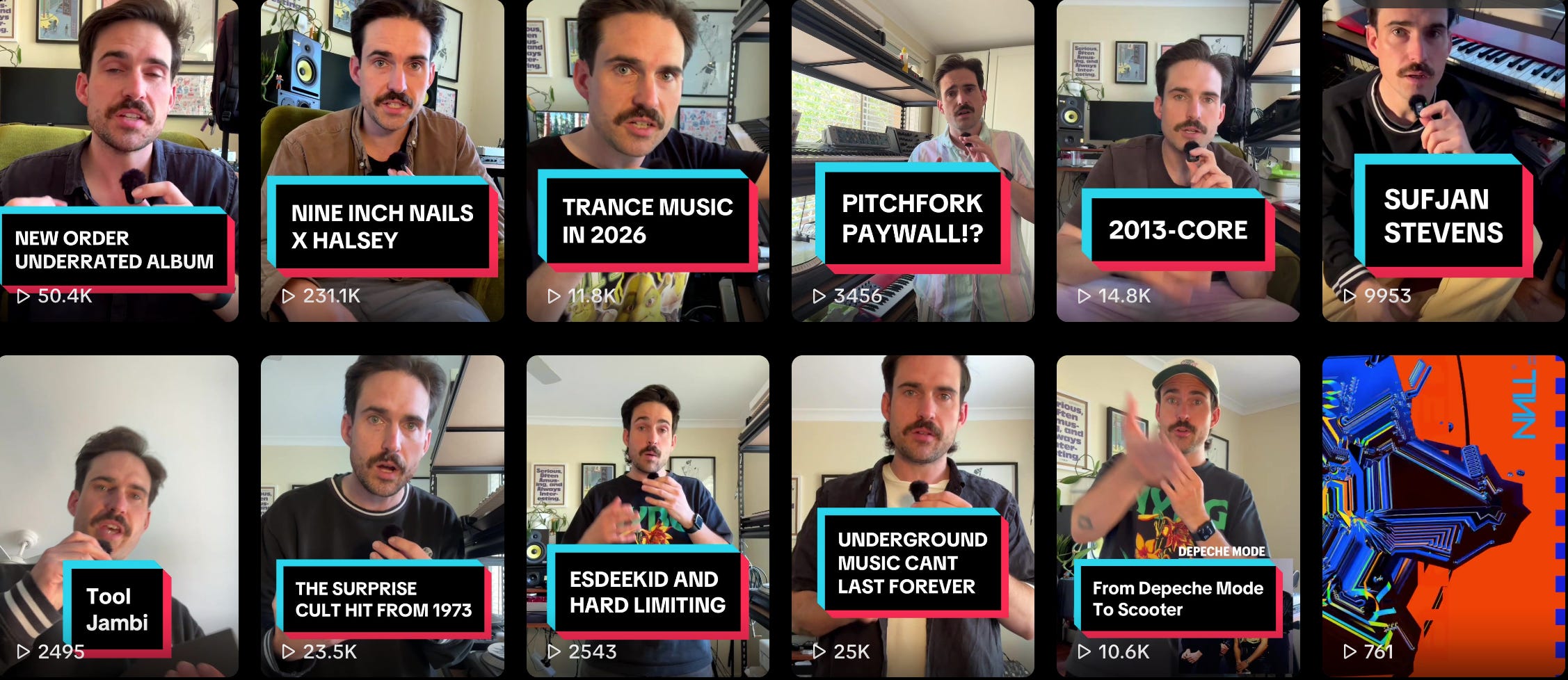
The likes of Derrick Gee, Marg.mp3, Verbatim Intern and Tia Ho have prevailed as dedicated, well informed and highly valued voices in the modern music scene. Their wealth of knowledge, prolific output and charisma has allowed them to foster large and dedicated audiences. Amongst these figures is Hayden Quinn (@null_electronics). I’ve known Hayden for many years, first through his electronic music alias Null. Null was a ‘faceless’ artist, leaning solely on the quality of the music and creative direction of the project (the music holds up strongly - check it here). In 2025 I saw Hayden begin posting face-to-camera videos that broke down niche moments in music history. It was nuanced, informative and engaging. Hayden’s knowledge was on display as he pulled back the curtain on musical theory and history that I wasn’t across.
Hayden’s grown his audience substantially, experimented with content, launched a podcast and reached millions of people. I wanted to know what’s he’s learnt, his approach and vision as a modern music critic. Enjoy the interview!
How would you describe your videos to someone new?
I talk about the music that means things to me and try to find the interesting stories behind them—especially stuff I can approach with a cynical point of view. I like to explore the marketing angles behind bigger cultural moments and the weird industry fuck-ups. I’m trying to highlight music that completely fell flat or that people think absolutely sucks, and convince them they’ve got it wrong. There’s a lot of merit in commercial flops.
How have your past experiences fed into your creative output?
Over the past 15 years of trying to make music and a music career, I’ve become incredibly disillusioned and bitter about how the music industry operates. There’s a freedom now that I’ve thrown the idea of “making it” out the window—I can be completely transparent about how I feel. That’s a big part of what I want to talk about. I’m inspired by people like John Safran, The Chaser and Shaun Micallef who do this kind of critical, investigative work.
How do you conceptualise and put together a video?
A lot of what I talk about is stuff I’ve wanted to discuss with friends, but I either get cut off or they’re not interested. Much of the music I recommend is stuff my friends have made fun of me for listening to. So it’s an outlet. I’ve never had anyone listen before, and now I have hundreds of thousands of people who want to hear about it. It’s stuff that’s been building up over years of being a huge music fan—thoughts I’ve always wanted to communicate but never could.
What are you trying to distill and express in your videos?
The main thing is that music is incredibly subjective. How people listen to it, enjoy it, and what they take away can all be different, even from the same piece of music. I’m also trying to distill the idea that all the marketing and bullshit around music—the manufactured essence of cool designed to sell records—is just as conceited and stupid as it was in the seventies, eighties, and nineties. It’s commercialization of art that listeners pretend to rally against while being sold to unknowingly. The artifice of cool and liking the right things is all so moronic. Whether it’s the Red Hot Chili Peppers or some exclusive unknown New York sound artist, it’s all just as valid. We should stop hanging our personalities on what we know and don’t know, and what we do and don’t enjoy in music.
What are you observing of your audience?
Some people don’t like me because I come across as bitter and cranky. I also think people sometimes miss that I’m extrapolating from reality and hypothesizing about how certain moments in music history operated. They don’t always understand that I’m exaggerating stories to make them entertaining, and sometimes saying things I don’t actually believe just to get a laugh. With talking-head videos, people forget it’s an extrapolation of television and entertainment. It’s not meant to be taken at face value—it’s a hyperbolized piece of entertainment designed to engage people. I’m taking artistic license to be entertaining and make myself chuckle, hopefully making others do the same.
What do you find works and doesn’t work with the platforms you post on?
Instagram and TikTok are basically opposite beasts. On Instagram, when I do vox pops, go to events, and do location-based interviews, that performs better because it feels local and gets distributed to people at those events. The long-form, heavily researched seven-to-fifteen-minute videos don’t do as well on Instagram because it pushes you to keep things under three minutes. On TikTok, the longer and more detailed the video, the better it performs algorithmically. But all the location-based interview stuff completely flops on TikTok because the algorithm is worldwide and can’t find people invested in local events.
Which creators, video makers, authors, artists, figures inspire your style?
I don’t really have any new content creators I get inspiration from. Most of it annoys and frustrates me—it all makes me cringe. That was actually a big hurdle to finding success myself because it’s hard to do something when all the examples make you cringe. What I’m trying to emulate is something more like what John Safran did in a TV show format, tweaked to fit social media. I’m aiming for documentary-style storytelling rather than useless content making.